No One Should Have to Translate Their Pain
A Practical Plan for Affordable, Spanish-Language Mental Health Care and a Better Crisis Response in Chicago
Leading a Better Chicago | July 2026
Our Position
A recent Instagram post raised a simple but urgent concern. The speaker described her recovery from post-traumatic stress disorder and the difficulty of needing mental health care but not being able to find it. When Leading a Better Chicago asked how it could support Latino residents in Little Village and Pilsen, her answer was clear: Chicago needs greater access to affordable mental health services provided in Spanish.
Leading a Better Chicago agrees.
When someone is ready to ask for help, the answer cannot be that there is no therapist who speaks the person’s language, no appointment available nearby, or no care the family can afford. Chicago should ensure that residents can obtain timely, affordable, culturally responsive mental health care in the language in which they can most fully express fear, trauma, grief, anxiety, and hope.
This issue is personal to me. My children are the grandchildren of immigrants, including a grandparent who immigrated to this country from Latin America. I have personally seen the challenges individuals and families face when they try to recognize a mental health need, understand what help is available, find a qualified provider, pay for treatment, and remain connected to care.
No individual or family should have to navigate that system alone.
Leading a Better Chicago supports four basic commitments:
- Affordable mental health care should be available in multiple languages including Spanish throughout Chicago.
- Residents should have one reliable place to find a provider who is actually accepting patients.
- Mental health professionals should be integrated into Chicago’s emergency-response system, including calls in which police must respond.
- Public funding should be measured by whether people receive and remain connected to care; not merely by dollars announced, contracts signed, or referrals made.
The Need Is Real in Chicago
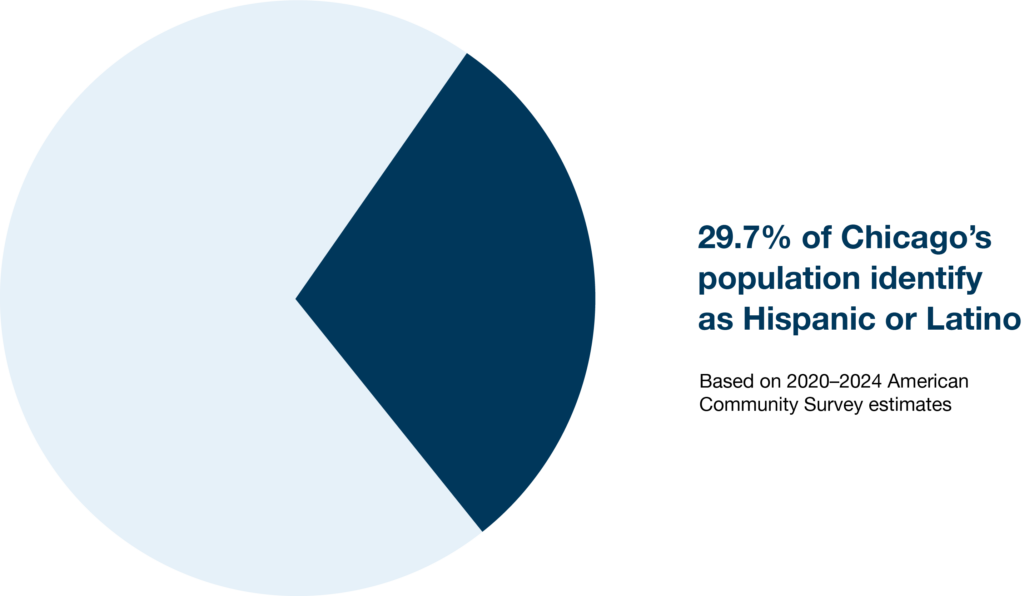
Latino residents are not a small or isolated part of Chicago. Based on 2020–2024 American Community Survey estimates, approximately 805,000 Chicago residents—29.7 percent of the city’s population—identify as Hispanic or Latino.
The need for meaningful Spanish-language capacity is especially clear in Little Village and Pilsen. Our founder, Bill Quinlan has represented as an attorney the largest mental health facility in Pilsen and have seen first-hand these challenges.
South Lawndale, which includes Little Village, is 80.7 percent Hispanic or Latino. Approximately 35 percent of its residents are foreign-born, 71.3 percent of residents age five or older speak Spanish at home, and 35.8 percent report speaking English less than “very well.” Approximately 13.9 percent of the community is uninsured, compared with 9.7 percent citywide.
The Lower West Side, which includes Pilsen, is 68.2 percent Hispanic or Latino. Approximately 35.4 percent of its residents are foreign-born, 58.5 percent of residents age five or older speak Spanish at home, and 24.7 percent report speaking English less than “very well.” Approximately 12 percent of residents are uninsured.
These numbers do not mean that every Latino resident wants or needs therapy in Spanish. They do establish that any mental health system serving Little Village, Pilsen, and similar Chicago communities must have substantial Spanish-language capacity.
A translated brochure is not enough. A bilingual receptionist is not enough. A telephone interpreter can be essential when no other option exists, but interpretation is not always an adequate substitute for therapy delivered directly by a qualified Spanish-speaking clinician.
Residents need professionals who can communicate directly with them, understand their cultural and family context, and build the trust necessary for treatment to work.
The Treatment Gap Is Larger Than the Diagnosis Gap
Mental illness, emotional distress, trauma, depression, and anxiety affect people of every background. The disparity is often not whether people experience these conditions. It is whether they receive treatment.
National data from the U.S. Department of Health and Human Services show that 20.7 percent of Hispanic or Latino adults reported a mental illness in 2024, compared with 23.4 percent of all American adults. Yet only 16.4 percent of Hispanic or Latino adults received mental health treatment, compared with 22.9 percent of adults overall. HHS calculates that Hispanic or Latino adults were 28 percent less likely than adults overall to have received mental health treatment during the year. These are national, not Chicago-specific, figures, but they demonstrate a significant treatment gap.
That gap does not have one cause.
- Cost and lack of insurance.
- Limited insurance networks.
- Shortages of bilingual clinicians.
- Long waiting periods.
- Work and family responsibilities.
- Transportation and scheduling difficulties.
- Uncertainty about where to seek help.
- Concerns about confidentiality.
- Fear related to immigration status.
- Stigma surrounding mental illness.
- A lack of providers who understand the patient’s language, history, family, and cultural experience.
People often wait until their condition becomes a crisis because ordinary outpatient support was unavailable, unaffordable, or too difficult to navigate when they first needed it.
That is harmful to the individual and the family. It is also costly to the entire city. Chicago smust make it easier to obtain help early rather than forcing residents to wait until they need an emergency room, a 911 response, or hospitalization.
Mental Health Care Depends on Language and Trust
Therapy and psychiatric care depend heavily on communication.
A clinician must understand not only a patient’s words, but also the meaning, emotion, hesitation, history, and cultural context behind those words. Someone discussing trauma should not have to search for English terminology, rely on a child or relative to interpret, or wonder whether an unfamiliar third party accurately conveyed a deeply personal experience.
The federal National Standards for Culturally and Linguistically Appropriate Services call for health organizations to provide understandable and respectful care that responds to patients’ preferred languages, cultural beliefs, health literacy, and communication needs. The standards also call for qualified language assistance, a culturally and linguistically responsive workforce, community engagement, and continuing measurement of whether services are working.
Chicago should distinguish among three necessary forms of language access:
Translated information includes websites, applications, consent forms, patient-rights materials, and information about available services.
Qualified interpretation is necessary when a clinician who speaks the patient’s language is not available. Interpretation should be provided by trained professionals, not children, relatives, or untrained employees.
Language-concordant care occurs when a qualified professional provides treatment directly in the patient’s preferred language.
All three are important. For continuing therapy, language-concordant care should occur whenever possible.
Chicago Has Made Investments, but Access Must Be Measured
Chicago is not starting from nothing.
The Chicago Department of Public Health currently operates seven mental health clinics and works with 53 partner organizations through the Healthy Chicago Mental Health Collective. City mental health centers offer outpatient services including screening, individual and group therapy, case management, and medication management, and the City states that services are provided free of charge to Chicagoans who are unable to pay.
The Pilsen South Ashland Health Hub offers mental health services by appointment in the Lower West Side community.
In April 2026, the City announced a $16.2 million expansion of its mental health safety net. The City reported that the preceding Mental Health Equity Initiative invested $57.9 million and enrolled more than 173,000 new clients between 2020 and 2025.
These are important investments and should be recognized. But they must also be evaluated.
The practical questions for a resident are not how many programs have been announced or how many organizations hold City contracts.
They are:
- Can I find a qualified provider who speaks Spanish?
- Is that provider accepting new patients?
- How long will I wait for an appointment?
- What will the care cost?
- Can I receive treatment in the evening or on a weekend?
- Will I be able to continue seeing the same clinician?
- What happens if I do not have insurance?
- What happens if I am in crisis tonight?
Chicago should be able to answer those questions clearly.
Enrollment is not the same as treatment. A referral is not the same as an appointment. An appointment is not the same as continuing care. The City must measure the entire path from the moment someone asks for help through the point at which the person receives treatment and remains connected to it. The City should hold itself accountable, publish those outcomes and do better!
Mental Health Expertise Must Be Part of Chicago’s Emergency Response
A June 30, 2026, Chicago Tribune editorial raised serious concerns about Chicago’s Crisis Assistance Response and Engagement program, commonly known as CARE. The editorial’s central point was correct: Chicago should not treat mental health expertise and public safety as competing systems.
Chicago launched CARE in 2021 as a multi-agency pilot. The City tested both a co-responder model which included a mental health clinician, a Chicago Fire Department community paramedic, and a specially trained Chicago police officer, and an alternative-response model consisting of a clinician and paramedic without a police officer.
The City later transferred CARE field operations to the Chicago Department of Public Health. Current field teams consist of a mental health crisis clinician and an emergency medical technician, and the City announced citywide expansion of the non-police response model in May 2026.
Sending clinicians instead of police to appropriate low-risk calls is a sound approach. A person experiencing depression, psychosis, trauma, or another psychiatric crisis may need assessment, de-escalation, treatment, and continuing care and not arrest.
But not every 911 call presents the same circumstances.
Some calls are clearly nonviolent and can safely be handled by clinicians and emergency medical personnel. Other calls involve incomplete information, possible violence, a weapon, threats of self-harm, a person behaving unpredictably, or police officers who are already at the scene. In those circumstances, Chicago should be able to send a mental health professional alongside police rather than requiring officers to manage a psychiatric emergency without clinical support.
According to the Tribune editorial, CARE responses peaked at 773 in 2023 and declined to 239 in 2024. The editorial also reported that the program lost access to key police dispatch technology and, as of June 2026, operated only on weekdays from approximately 10 a.m. until 4:30 p.m. The administration reportedly planned to add a second evening shift by October.
Those figures raise questions that City Hall must answer. Geographic expansion does not create meaningful access if teams are unavailable when crises occur, if dispatchers do not send them, or if police officers cannot obtain clinical assistance when they need it.
The University of Chicago Health Lab’s evaluation demonstrates that CARE has real potential. Between September 2021 and October 2023, CARE teams responded to 1,348 events and served 673 individuals. Participants’ self-reported distress scores declined by an average of 19 percent after interacting with CARE clinicians, although the researchers cautioned that the evaluation could not establish a causal relationship.
The evaluation also concluded that 911 professionals are essential to successful crisis response and that staffing, stable funding, cross-agency cooperation, clear procedures, data sharing, and trusted working relationships among dispatchers and responders are critical to effective implementation.
The conclusion should not be that police must accompany clinicians to every call. Nor should clinicians be sent into situations that are unsafe.
The conclusion is that Chicago needs several response options and must send the right professionals based on the circumstances.
Chicago should be able to answer those questions clearly.
We should not ask police officers to become therapists, and we should not ask clinicians to perform police work. Public health and public safety must work together.
Leading A Better Chicago’s Plan
1. Establish a Spanish-Language Mental Health Access Guarantee
Chicago should establish clear access standards for City-operated and City-funded providers.
For a Spanish-speaking resident seeking care, the system should provide:
- Immediate screening when there is a danger of self-harm, violence, or another urgent safety concern.
- An initial non-emergency assessment within seven days.
- A first clinical appointment within 14 days.
- Treatment delivered directly in Spanish whenever qualified capacity is available.
- Qualified professional interpretation when language-concordant treatment is temporarily unavailable.
- Continuing treatment with the same clinician whenever clinically appropriate.
- A direct referral and confirmed appointment with another provider when the first provider cannot meet the standard.
These standards should begin with pilots in Little Village and Pilsen and expand to other neighborhoods based on need, language data, and actual service capacity.
An access guarantee does not mean that every patient will receive the same treatment. It means every patient will receive a timely response, a professional assessment, and a realistic path to care.
2. Create One Reliable Place to Find Help
Chicago residents should not have to call provider after provider only to learn that a clinic is not accepting new patients, does not accept their insurance, or does not actually have a Spanish-speaking therapist available.
The City should maintain a verified directory showing:
- Providers accepting new patients.
- Languages in which treatment is directly available.
- Whether services are for adults, children, or both.
- Types of treatment offered.
- Insurance accepted.
- Free and sliding-scale options.
- Expected waiting time.
- Evening, weekend, telehealth, and in-person availability.
- Accessibility for people with disabilities.
Residents should be able to obtain the same information in Spanish online, by telephone, or through a trained community navigator.
The information should be verified regularly. An outdated list is not a resource. It is another dead end.
Each person requesting assistance should also be offered a navigator who can help schedule an appointment, complete forms, understand cost and insurance requirements, arrange interpretation, and follow up when a referral does not result in care.
Access to healthcare is a right for every Chicagoan.
3. Pay for Real Spanish-Language Capacity
Chicago cannot require providers to expand language access without addressing the cost of recruiting, training, supervising, and retaining qualified professionals.
City and State contracts should provide appropriate support for:
- Bilingual therapists, psychologists, psychiatrists, counselors, social workers, and case managers.
- Spanish-language clinical supervision.
- Qualified behavioral health interpreters.
- Translation of intake, consent, discharge, treatment, and patient-rights materials.
- Training in culturally responsive and trauma-informed care.
- Evening and weekend appointments.
- Telehealth technology and private spaces from which patients can participate.
- Administrative assistance necessary to maintain continuity of care.
Contracts should distinguish between a provider that happens to employ a bilingual staff member and one with sufficient clinical capacity to accept and consistently treat Spanish-speaking patients.
Chicago and the State of Illinois should pay for actual capacity; not allow an organization to check a box marked “Spanish available.”
4. Build a Bilingual Behavioral Health Workforce
Chicago’s long-term challenge cannot be solved simply by moving a limited number of clinicians from one provider to another. The region needs more qualified bilingual mental health professionals.
Chicago should work with universities, community colleges, hospitals, health centers, and community organizations to create a bilingual behavioral health workforce pipeline.
That initiative should include:
- Scholarships for bilingual Chicago residents pursuing behavioral health careers.
- Paid internships and clinical placements in underserved communities.
- Loan-repayment assistance for professionals who provide Spanish-language care in Chicago.
- Assistance with licensing fees, examinations, and required supervision.
- Stipends for experienced clinicians who supervise bilingual trainees.
- Career pathways for community health workers, peer-support specialists, and behavioral health navigators.
- Recruitment of professionals with lived experience and meaningful ties to the communities they serve.
- Training for bilingual employees who need additional preparation to provide clinical services safely and effectively.
Speaking Spanish does not, by itself, qualify someone to provide therapy. Holding a professional license does not, by itself, make someone culturally responsive.
Chicago needs both clinical competence and meaningful language capacity.
5. Bring Services into Trusted Community Settings
Mental health care should not exist only behind the doors of a traditional clinic.
Chicago should expand partnerships that make screening, navigation, support groups, and appropriate clinical services available through trusted institutions, including:
- Community health centers.
- Schools and colleges.
- Churches and faith communities.
- Libraries.
- Immigrant-serving organizations.
- Domestic-violence organizations.
- Community centers.
- Youth and family-service organizations.
- Organizations serving older adults.
- Workplaces and labor organizations.
The objective is not to turn every community institution into a mental health clinic. It is to allow trusted institutions to become safe and familiar entry points to professional care.
Services must also be available during evenings and weekends. A resident who works two jobs, provides child care, or cannot take unpaid time off should not be excluded because appointments are available only during ordinary business hours.
6. Make Care Available Regardless of Insurance or Immigration Status
The City states that its mental health centers provide free services to Chicago residents who cannot afford to pay. Community health centers also serve residents regardless of their ability to pay and include providers that work with undocumented individuals and families.
That commitment should be communicated clearly and consistently throughout the publicly funded system.
Every participating provider should explain in Spanish:
- Whether care is free or offered on a sliding scale.
- Which insurance plans are accepted.
- What an uninsured patient will be charged.
- Whether identification is required.
- What information will be collected.
- How personal and medical information will be protected.
- That a patient does not need to use a child or relative as an interpreter.
- Where the patient can seek help if the provider has no available appointment.
No one should avoid treatment because the person misunderstands the cost or fears that seeking care will expose unrelated personal or immigration information.
7. Provide Trauma-Informed and Culturally Responsive Care
The Instagram post’s discussion of PTSD is an important reminder that trauma takes many forms.
Trauma may result from violence, abuse, an accident, military service, family separation, displacement, discrimination, dangerous work, or experiences before, during, or after migration. It may affect someone born and raised in Chicago or someone who recently arrived.
Treatment should not assume that every Latino patient has the same history, culture, immigration experience, or family structure. Chicago’s Latino communities are diverse.
Culturally responsive care means listening to the individual rather than reducing that person to a demographic category. It also means understanding how family, faith, work, community, gender expectations, immigration history, and stigma may affect whether someone seeks help and remains in treatment.
The best policies will be developed with and not merely for the communities they are intended to serve. Residents with lived experience should participate in designing, evaluating, and improving the system.
8. Build a Flexible, Twenty-Four-Hour Crisis-Response System
Chicago should not force a false choice between sending a police officer and sending a mental health professional.
The City should maintain several coordinated response options.
Clinician-Led Response
For calls reasonably identified as nonviolent and low risk, Chicago should send a mental health clinician and an EMT without police.
The team should be trained to conduct assessment, de-escalation, service referral, care coordination, and voluntary transportation when appropriate.
Clinician and Police Co-Response
When a call involves uncertain risk, possible violence, a weapon, threats of self-harm, or police officers already at the scene, Chicago should be able to send a clinician alongside police.
The clinician should lead the behavioral health assessment and de-escalation when conditions permit. Officers should address any immediate safety risk.
A police officer encountering someone in crisis should be able to request clinical support immediately. That assistance should not depend on whether the crisis happens during weekday business hours.
Clinical Support in the 911 Center
Licensed behavioral health professionals should be available within Chicago’s emergency communications system around the clock.
They should assist dispatchers in:
- Identifying mental health calls.
- Assessing the available risk information.
- Determining the appropriate type of response.
- Supporting callers while a team is dispatched.
- Advising responding personnel.
- Connecting non-emergency callers with appropriate services.
The University of Chicago evaluation identified 911 professionals as critical gatekeepers and found that training, communication, familiarity with CARE, and trust between dispatchers and response teams were essential to effective deployment.
Shared Dispatch Information
CARE teams should have secure access to the real-time information they need to respond safely and effectively.
Police, fire, dispatch, and public-health personnel should operate under clear protocols governing:
- Which calls qualify for each response model.
- When CARE may be dispatched directly.
- When police or fire personnel may request CARE assistance.
- When CARE should request police support.
- What information may be shared.
- How sensitive health information will be protected.
- How calls and outcomes will be documented.
Departments cannot coordinate effectively when they operate from different information and incompatible procedures.
Twenty-Four-Hour Availability
Chicago should establish a phased plan for CARE availability 24 hours a day, seven days a week.
The City should begin by extending service into evenings, overnight periods with demonstrated demand, and weekends, and then move toward continuous coverage.
A psychiatric emergency does not become less serious because it occurs after 4:30 p.m.
Spanish-Language Crisis Response
In communities such as Little Village and Pilsen, Chicago should ensure access to bilingual crisis clinicians or qualified behavioral health interpreters.
A person experiencing PTSD, psychosis, suicidal thoughts, or another crisis should not have to communicate through a child, an untrained relative, a police officer, or a bystander.
When a Spanish-speaking clinician cannot respond immediately, qualified interpretation should be provided and prompt follow-up should be arranged with a Spanish-speaking provider.
Connection to Continuing Care
A successful crisis response cannot end when the van, ambulance, or police vehicle leaves.
Every person assisted by CARE or identified by police or emergency medical personnel as experiencing a mental health crisis should receive:
- Follow-up within 24 to 48 hours.
- Assistance scheduling an outpatient appointment.
- Information in the person’s preferred language.
- Help understanding insurance, free-care, and sliding-scale options.
- Connection to housing, substance-use treatment, domestic-violence services, food assistance, or other supports when appropriate.
- A named person or organization responsible for confirming whether the connection occurred.
The purpose of crisis response should not be merely to stabilize the moment. It should be to reduce the likelihood that the person must return repeatedly to 911 because the underlying need was never addressed.
9. Use Trusted Community Voices to Reduce Stigma
Chicago should work with clinicians, residents, faith leaders, community organizations, small-business owners, artists, and local content creators to normalize conversations about mental health.
The message should be straightforward:
- Asking for help is not weakness.
- Therapy is not only for moments of crisis.
- PTSD, anxiety, depression, and grief are treatable.
- Care is confidential.
- Services should be available in Spanish.
- A family member can support treatment without replacing a professional.
- People with lived experience should help shape the system.
The Instagram post that prompted this paper demonstrates why community voices matter. A person speaking honestly about her own recovery can reach people who may never read a government report or visit a public-health website.
But outreach must lead somewhere. Every post, advertisement, public event, and community conversation should direct residents to verified services that are accepting patients and capable of providing the promised care.
10. Measure Whether the System Actually Works
Chicago must publish a clear mental health access and crisis-response dashboard while protecting patient privacy. It must hold itself accountable to better outcomes that demand result and evaluate the system to continue to make it better.
For publicly funded outpatient services, the City should report:
- The number of clinicians providing treatment directly in Spanish.
- The number of providers accepting new patients.
- Average time from first contact to assessment.
- Average time from assessment to treatment.
- The number of people placed on waiting lists.
- The number referred elsewhere because capacity was unavailable.
- The percentage of referrals resulting in an appointment.
- Continuity and retention in treatment.
- Evening, weekend, in-person, and telehealth availability.
- Patient satisfaction by preferred language.
For CARE and other crisis responses, the City should report:
- The number of mental health-related 911 calls.
- The number receiving clinician-only, co-response, police-only, and Fire Department responses.
- Average dispatch and response times.
- The hours and neighborhoods in which CARE was available.
- Calls that did not receive CARE assistance because no team was available.
- Arrests, uses of force, emergency-room transports, and voluntary treatment connections.
- Follow-up services provided.
- Outcomes by neighborhood and preferred language.
The purpose is not to shame organizations serving difficult populations with limited resources. It is to identify where capacity is insufficient and direct resources accordingly.
Chicago should stop measuring success primarily by money announced, contracts awarded, people enrolled, or referrals issued. We must demand result and continue to imporove.
Success is whether people receive appropriate care, whether they receive it in time, and whether they remain connected to it.
A Practical Implementation Plan
During the First 90 Days
Chicago should identify every publicly funded behavioral health provider serving Little Village and Pilsen and verify:
- Current Spanish-language clinical capacity.
- Whether providers are accepting new patients.
- Available appointment times.
- Waiting lists.
- Cost and insurance requirements.
- Evening and weekend availability.
- The number of patients referred elsewhere.
- The availability of crisis follow-up.
The City should also convene residents, clinicians, community health centers, schools, faith communities, immigrant-serving organizations, first responders, 911 professionals, and people with lived experience to refine the access and crisis-response standards.
Within Six Months
Chicago should launch coordinated Spanish-language access pilots in Little Village and Pilsen that include:
- A centralized navigation service.
- Published maximum waiting-time standards.
- Bilingual workforce incentives.
- Extended service hours.
- Community-based outreach.
- Partnerships with trusted neighborhood institutions.
- A defined process for following residents from referral to appointment.
- Spanish-language crisis-response capability.
- Public reporting of wait times and available capacity.
Within One Year
An independent evaluation should determine:
- Whether more residents obtained treatment.
- Whether waiting periods declined.
- Whether patients remained connected to care.
- Whether providers increased Spanish-language capacity.
- Whether residents understood how and where to seek help.
- Whether CARE and 911 dispatch became more coordinated.
- Whether people received appropriate follow-up after a crisis.
- What the program cost per person successfully connected to care.
Programs that work should be expanded. Programs that do not should be corrected rather than protected because they were announced at a press conference.
Conclusion
Mental health care is health care.
A resident should not have to wait until a crisis to receive help. A person should not have to explain trauma through an untrained relative. An uninsured worker should not assume that treatment is impossible. A Spanish-speaking parent should not have to call ten providers before finding one who can communicate directly and meaningfully.
And when a crisis does occur, a police officer should not be left to manage a psychiatric emergency alone simply because the City has separated its public-health and public-safety responses.
Chicago has started meaningful mental health programs. The next step is to ensure those programs are invested in and produce timely, affordable, language-concordant care in the neighborhoods where it is needed and an emergency-response system that sends the right help at the right time.
This is not about creating another bureaucracy. It is about making the system we already fund work for the people it is supposed to serve.
Leading a Better Chicago supports a clear commitment: when a Chicagoan is ready to ask for help, that help should be available, affordable, close to home, connected to the City’s broader emergency-response system, and provided in the language in which that person can truly be heard.
No one should have to translate their pain before Chicago is willing to help them heal.