
Strong Small Businesses. Stronger Neighborhoods.
A Practical Agenda to Help Chicago Businesses Open, Grow, and Stay
The video filmed at Cleo Southern Kitchen captures a simple but important truth: supporting a neighborhood business is an investment in the neighborhood itself.
Local restaurants, retailers, service providers, contractors, and family-owned businesses create jobs, occupy storefronts, bring people together, and help give Chicago’s neighborhoods their identity. Research by the Urban Institute describes healthy commercial corridors as centers of entrepreneurship, employment, wealth creation, community engagement, cultural identity, and social connection.
Leading a Better Chicago believes small-business policy must be treated as more than an economic-development program. It is also a neighborhood-development strategy, a jobs strategy, and one part of a comprehensive public-safety strategy.
Chicago has programs designed to help small businesses, and some of them provide meaningful assistance. But too often, business owners must navigate different agencies, eligibility maps, application periods, financing requirements, permits, inspections, and reimbursement rules on their own.
Our goal should be straightforward:
Make Chicago the easiest major city in America in which to open a responsible business, keep it open, hire people, and grow.
Small-business owners are willing to take risks and invest in Chicago. City government should help them succeed rather than become another obstacle they must overcome.
Why Small Businesses Matter
They create jobs and economic opportunity
Small businesses are a significant part of Illinois’ economy. Between March 2023 and March 2024, Illinois small-business establishments recorded 323,299 job gains and 309,168 job losses, producing a net increase of 14,131 jobs. In 2023, banks reporting under the Community Reinvestment Act also originated $3.3 billion in loans to Illinois businesses with annual revenues of $1 million or less. These are statewide figures, not Chicago-only figures, but they demonstrate the scale of small-business activity and the importance of access to capital.
Behind those numbers are real opportunities: a first job for a teenager, a second chance for someone returning to the workforce, a career for a neighborhood resident, and a path to ownership for an entrepreneur willing to bet on Chicago.

They strengthen neighborhoods
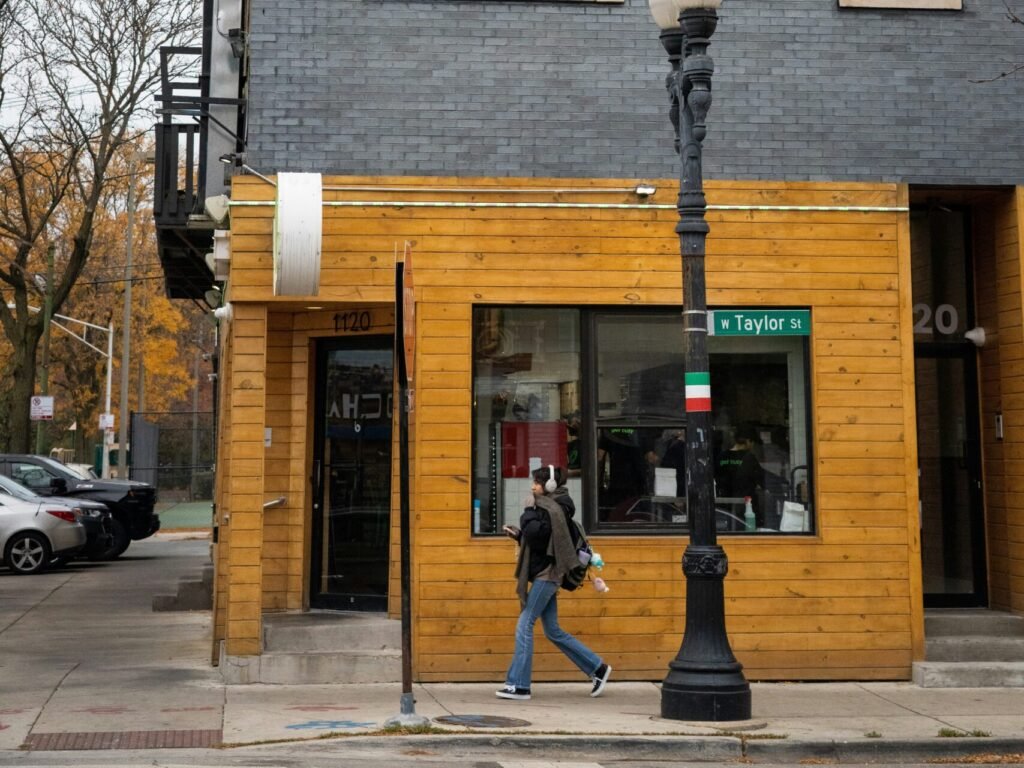
A successful neighborhood business does more than employ its own workers. It attracts customers, supports nearby businesses, fills an otherwise vacant property, and gives residents another reason to spend time in their community.
A restaurant can become a gathering place. A grocery store can provide an essential service. A salon, coffee shop, bookstore, repair shop, or cultural venue can become part of a neighborhood’s identity.
When locally rooted businesses disappear, Chicago can lose more than jobs and tax revenue. It can lose relationships, history, convenience, and part of what makes a neighborhood distinctive.
Active commercial corridors can contribute to public safety
A neighborhood business is not a substitute for effective policing, responsible prosecution, mental-health services, violence-prevention programs, or other public-safety measures. We should not claim that opening one restaurant will, by itself, prevent crime.
The evidence does suggest, however, that organized investment in commercial corridors can complement traditional public-safety strategies. A study of business improvement districts in Los Angeles found that implementation was associated with approximately 28 fewer serious crimes per neighborhood, an 11 percent relative decline. Those districts combined business participation with coordinated services and investment in the surrounding area.
The lesson is not that private businesses should take over the government’s public-safety responsibilities. The lesson is that clean, active, well-lit, and well-managed commercial corridors—supported by businesses, residents, police, service providers, and local government—can help create safer and more welcoming neighborhoods.

Chicago Has Programs, but Business Owners Need a System
Chicago already operates several important small-business programs.
The Neighborhood Opportunity Fund provides grants of up to $250,000 for qualifying small-business and cultural projects along eligible West, Southwest, and South Side commercial corridors. Grants may cover up to 75 percent of eligible project expenses and are accessed through reimbursement or an approved construction escrow process.
The Small Business Improvement Fund provides reimbursement grants for permanent building improvements in eligible tax increment financing districts. Depending on the applicant and property, commercial projects may receive reimbursement of 30, 60, or 90 percent of eligible costs. Maximum grants are generally $150,000 for single-owner commercial properties, while qualifying multi-tenant commercial and industrial properties may receive up to $250,000, subject to program limits.
The Commercial Corridor Storefront Activation program is investing $30.5 million across 12 designated business corridors. It provides grants covering up to 75 percent of qualifying project costs, together with assistance involving design, permitting, accounting, marketing, and business planning.
Chicago also describes its Small Business Center as a one-stop shop for business licensing, public-way permitting, and resources to help businesses start and grow.
These programs are valuable. The problem is that they do not always feel like one coordinated system to the person trying to open or expand a business.
Reimbursement programs can also create a cash-flow problem. A grant may be approved, but the business owner may still need financing, working capital, professional assistance, and money to pay expenses before reimbursement is available.
A 2019 Urban Institute evaluation of the Neighborhood Opportunity Fund found that entrepreneurs frequently needed more than grant money. They also required help obtaining loans, preparing budgets and business plans, managing construction, navigating permitting and licensing, and dealing with unexpected costs.
Chicago should build upon the programs that work while making the overall system simpler, faster, and more useful.
Leading a Better Chicago’s Small-Business Agenda
1. Give Every Business Owner One Front Door
An entrepreneur should not have to become an expert in City Hall simply to open a lawful business.
Chicago should assign every applicant a small-business navigator who remains responsible for the matter from the initial inquiry through final approval. The applicant should receive:
- One identification number for the entire matter.
- One complete checklist of required licenses, permits, inspections, zoning approvals, and documents.
- A written timeline showing which agency is responsible for each step.
- Online access to the status of every application.
- Prompt notice of missing or incomplete information.
- A clearly identified person to contact when the process stalls.
Chicago should also establish a Small-Business Approval Guarantee. Once a complete application is submitted, the City should be required within a reasonable and published period to approve it, deny it with a specific written explanation, or identify precisely what remains to be completed and when the necessary review or inspection will occur.
The City already calls its Small Business Center a one-stop shop. We should make that promise real and measurable.
2. Turn Approved Grants into Capital Businesses Can Use
A business owner should not receive a grant approval and then discover that the business cannot afford to access it.
Chicago should create a coordinated financing system for qualified grant recipients that includes:
- Short-term bridge loans tied to approved grants.
- Greater use of construction escrow and direct contractor payments.
- Predevelopment assistance for architecture, engineering, permitting, legal, and licensing costs.
- Small emergency grants for vandalism, equipment failures, or repairs that could otherwise force a business to close.
- Partnerships with community development financial institutions and participating banks.
- Financial, construction, and project-management assistance before money is spent.
Public money must be protected through documentation, verification of completed work, and appropriate oversight. But oversight should protect taxpayers without making assistance practically unavailable to the businesses that need it most.
3. Create Neighborhood Business and Safety Partnerships
Chicago should establish voluntary partnerships along selected commercial corridors. Each partnership should include local businesses, residents, chambers of commerce, special service areas, police districts, violence-prevention organizations, social-service providers, and relevant City departments.
Each corridor should have a practical action plan addressing:
- Lighting and visibility.
- Graffiti, litter, illegal dumping, and sanitation.
- Vacant or poorly maintained properties.
- Safe access to transit and parking.
- Recurring public-safety concerns.
- Outreach for people experiencing homelessness, addiction, or behavioral-health crises.
- Coordinated community events that generate legitimate foot traffic.
- Faster communication between businesses and City agencies.
The goal is not to privatize policing. It is to make sure that businesses and government are working together to address the conditions that affect whether a commercial corridor feels safe, active, and cared for.
4. Fill Vacant Storefronts and Bring Customers Back to Commercial Corridors
An empty storefront does not affect only the property owner. It reduces activity, hurts neighboring businesses, and can make an entire block appear neglected.
Chicago should:
- Create a searchable inventory of vacant commercial spaces.
- Develop standard short-term leases for pop-up businesses.
- Provide targeted assistance for entrepreneurs testing a concept before signing a long-term lease.
- Accelerate approvals for safe temporary uses.
- Encourage landlords to make long-vacant spaces available at reduced introductory rents.
- Coordinate storefront improvements with lighting, sanitation, transit, streetscape, and public-safety investments.
- Expand successful storefront-activation efforts based on measurable results.
City government cannot guarantee customers. It can, however, remove unnecessary obstacles and help create an environment in which businesses have a fair chance to succeed.
5. Make Chicago a Better Customer of Chicago Businesses
Chicago and its participating public agencies have enormous purchasing power. At the time this paper was prepared, the City’s searchable buying plan identified 598 anticipated contracting opportunities across 23 agencies, with an estimated total value of approximately $3.4 billion. These are projected opportunities, not dollars already awarded or paid to small businesses.
Chicago should use this purchasing power to provide qualified local businesses with a fair opportunity to compete.
The City and participating agencies should:
- Publish anticipated purchasing needs as early as possible.
- Break appropriate contracts into smaller bid packages.
- Simplify registration, certification, and renewal requirements.
- Provide practical assistance with bid preparation and contract administration.
- Expand opportunities for small businesses to serve as prime contractors.
- Establish and enforce prompt-payment standards.
- Publish how much work is actually awarded and paid to Chicago-based small businesses.
- Track whether small contractors are able to progress from small orders to larger opportunities.
The measure of success should not be how many programs exist. It should be how many neighborhood businesses actually receive contracts, complete the work, are paid on time, and become stronger as a result.
6. Connect Business Growth with Jobs for Chicago Residents
When Chicago helps a business grow, Chicago residents should have an opportunity to share in that growth.
Businesses receiving significant public assistance should be encouraged to recruit locally and partner with:
- Chicago high schools and community colleges.
- Apprenticeship and workforce-training programs.
- Organizations serving returning residents.
- Youth-employment programs.
- Neighborhood social-service and community organizations.
Reporting requirements should be proportional to the amount of assistance received. A small restaurant receiving a modest grant should not face the same administrative obligations as a major developer receiving substantial public support.
The objective should be to connect residents with real employment and advancement opportunities, not to create another paperwork exercise.
7. Promote Chicago’s Neighborhood Businesses
Chicago should tell the stories of the people who invest in its neighborhoods.
Leading a Better Chicago supports a Buy Chicago Neighborhoods initiative built around:
- Neighborhood business directories.
- Restaurant, retail, arts, and cultural trails.
- Partnerships with chambers of commerce and community organizations.
- Influencer and creator campaigns.
- Cross-promotion among nearby businesses.
- Marketing assistance for businesses without professional digital resources.
- Events that encourage residents and visitors to explore neighborhood commercial corridors.
The Cleo Southern Kitchen video demonstrates how this can work. People may not begin by reading a policy paper about commercial-corridor development. They may begin by watching someone they trust visit a local restaurant, meet the people behind it, and explain why supporting that business matters.
The social content creates attention. The policy should follow with practical solutions.
8. Understand the Cost Before Adding Another Burden
Chicago must enforce reasonable health, safety, wage, employment, and consumer-protection standards. Supporting small businesses does not mean eliminating responsible regulation.
It does mean understanding the cumulative effect of taxes, fees, licenses, inspections, mandates, and reporting requirements.
Before imposing a new tax, fee, mandate, or significant reporting obligation, Chicago should publish a Small-Business Impact Statement explaining:
- Which businesses will be affected.
- The expected cost of compliance.
- Whether the proposal affects a neighborhood business differently from a large corporation.
- Whether less burdensome alternatives exist.
- How the new requirement interacts with obligations already in place.
- What measurable public benefit the proposal is expected to produce.
Small businesses should not be an afterthought after a policy has already been designed. Their practical experience should be considered before the decision is made.
Measure Results, Not Announcements
Chicago should begin this strategy with pilot commercial corridors representing different neighborhoods, business communities, and economic conditions.
Before the pilots begin, the City should publish baseline information and then report results quarterly. Measures should include:
- Vacant and occupied storefronts.
- Business openings and closures.
- Licensing and permitting times.
- Public and private investment.
- Jobs created and retained.
- Pedestrian activity.
- Reported crime and perceptions of safety.
- City contracts awarded to participating businesses.
- Average payment times.
- Businesses receiving capital and technical assistance.
Programs that work should be expanded. Programs that do not produce results should be changed or discontinued.
Success should not be measured by the number of press conferences held, dollars announced, or applications received. It should be measured by whether businesses open, survive, hire people, attract customers, and strengthen the neighborhoods around them.
Conclusion
Chicago’s small businesses are pillars of their communities.
They create jobs. They fill storefronts. They provide essential services. They preserve neighborhood identity. They bring people together. They give residents a reason to believe that their community has a future.
Supporting a business like Cleo Southern Kitchen is not only about enjoying a meal. It is about recognizing and supporting the people who take the risk to open their doors, employ their neighbors, invest their savings, and build something in Chicago.
Those entrepreneurs should not have to succeed in spite of City government.
Leading a Better Chicago supports a practical partnership with small businesses based on clear rules, faster decisions, accessible capital, safer and cleaner commercial corridors, local purchasing, workforce opportunities, sensible regulation, and measurable accountability.
Strong small businesses help build strong neighborhoods. Strong neighborhoods will build a better Chicago.